Everyone Who's Ever Managed a Drink List Knows This
Picture it: end of the month. You pick up the list and start counting. But Thomas's column has somehow run off into nowhere. Someone wrote with the wrong pen and smeared everything. Was that one mark or two? And €22 is missing, and nobody can explain where it went.
Sound familiar? Welcome to the club — in the truest sense of the word.
The problem isn't a lack of willingness from people. The problem is the tool. A paper tally sheet is simply not reliable enough for a group of more than five people. It's error-prone, lacks transparency, and ends up creating more work than it saves.
Why Paper Drink Lists Fail
Whether you're in charge of the office coffee fund, managing the club treasury at a sports club, or organizing the fridge at a coworking space — the tally sheet has the same structural weaknesses:
The list becomes illegible. After two weeks, the sheet looks like a hieroglyphics collection. Marks, scribbles, crossed-out lines. Which of those were intentional?
Nobody knows how much they owe. Unless you actively count — which hardly anyone does regularly. Result: nasty surprises when it comes time to settle up.
Settlement wastes unnecessary time. Someone has to add everything up, calculate amounts, remind people, and collect money. It's work that nobody really enjoys — and it usually falls on the same one or two people.
Losses stay invisible. If a product goes missing without anyone logging it, you only notice at the next shopping run — if at all. What's missing then isn't just the product, but any way of understanding what actually happened.
What the Digital Alternative Does Better
A digital tally sheet doesn't automatically solve all the problems of human forgetfulness. But it makes a lot of things significantly easier and more transparent.
The principle stays the same: whoever takes something, logs it. The difference is in how that happens and what automatically follows.
Logging in seconds. A good system needs no more than three taps: select a name, tap a product, done. Faster than making a mark — and more reliable, because the correct amount is immediately deducted.
Everyone sees their balance. No more guessing. Every member sees in real time how much credit they have left — and gets a warning before their account runs dry.
The overview is always there. Whoever manages the fund can see at a glance: what was consumed? Who still owes money? When does something need to be reordered? All without manual counting or calculating.
Losses become visible. When products are missing during a stock check, it shows up as an entry. Broken bottles, counting errors, missed logs — everything can be documented and traced.
No installation needed. The best solutions run directly in the browser — on the tablet next to the fridge, on the club room computer, or on a smartphone.
Who Benefits from a Digital Drink List?
Offices and teams — coffee fund, fridge, snack bar. Someone always ends up being the one who manages all of it. With a digital system, it just runs — without constant reminders and follow-ups.
Clubs and associations — whether it's a sports club, music society, or volunteer fire brigade: the club room almost always has a fridge, and the drink fund has been a recurring headache for years. A tablet next to the fridge, set up once, and the problem is solved.
Coworking spaces and collectives — shared spaces with rotating users are the ultimate challenge for tally sheet management. Digital systems work particularly well here because they require no personal logins and no prior registration.
Volunteer fire brigades and nonprofits — every hour spent on administration is an hour taken away from something else. A system that automates the bookkeeping isn't a nice-to-have here — it's genuine relief for people who are already giving a lot.
Workshops and makerspaces — often very diverse groups with varying usage times. A shared tablet as a point-of-sale system makes particular sense here because everyone uses the same device — regardless of their own smartphone.
What This Setup Looks Like in Practice
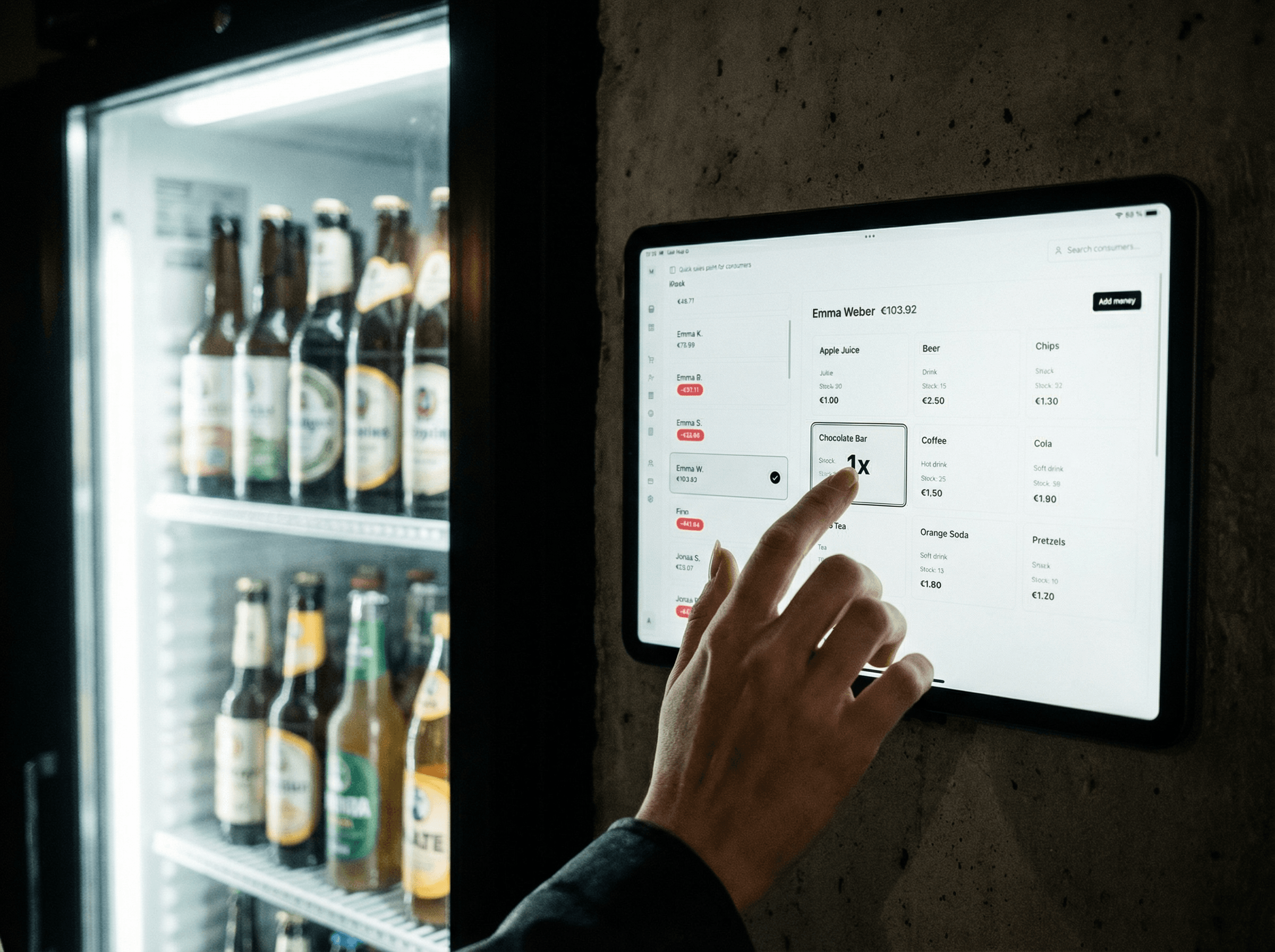
The recommended setup is remarkably simple: an inexpensive tablet, wall-mounted or on a stand, right next to the fridge or storage area. The tablet permanently opens the app — and your digital fund is ready to go.
With Tapper, it works like this:
Members tap their name, select a product, and the booking is done in under ten seconds. The amount is automatically deducted from their credit. If the credit runs low, a reminder appears. Anyone adding money — whether in cash, by bank transfer, or via PayPal — submits a top-up request that the admin quickly confirms.
On the admin side, you see everything at once: which products were booked how often, whose account is in the negative, what needs to be reordered, and how the fund is doing overall. No spreadsheets. No counting. No guesswork.
Tapper runs as a web app directly in the browser — no app installation, no account required for members. If you want, you can additionally secure the tablet with a kiosk app so it stays permanently on Tapper and nobody accidentally navigates away.
What Does It Cost, and Is It Worth Switching?
Tapper is free to test — with up to 3 members and full functionality. For small clubs or teams, there are affordable plans starting from 50 member slots. Archived members don't count toward the limit, so the system scales long-term even with changing membership.
Is it worth it? Do a quick calculation: if you or someone in your club spends two hours a month managing, counting, and chasing drink money, a digital solution pays for itself after the very first month — even if you value that volunteer time at nothing.
And the side effect that people underestimate: less frustration, fewer quiet conflicts, more fairness. When everyone can see what they owe at any time, there's no need to argue about "unfair distribution" or "but I already paid."
Conclusion: The Tally Sheet Was Good. Digital Is Better.
The paper tally sheet had its time. It was simple, it was free, and it worked — as long as the group was small enough and everyone was conscientious enough.
For everyone else, switching to a digital solution isn't a big change anymore. It's just as easy to use, costs almost nothing, and saves a lot of hassle.
Once it's set up, it just runs. And that's really the best thing you can say about any management system.